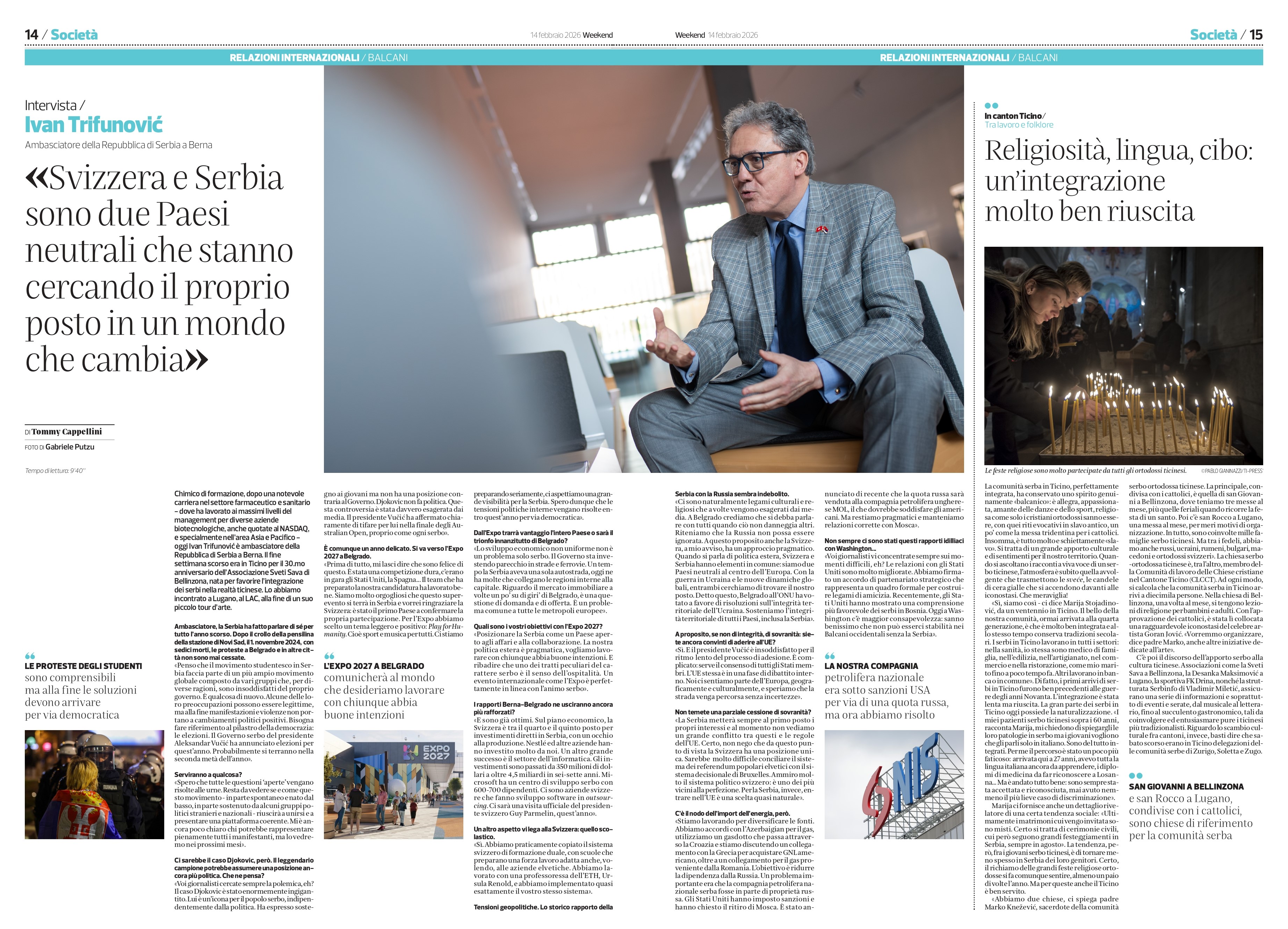

Interview with Ambassador Ivan Trifunović for Corriere del Ticino
“Switzerland and Serbia are two neutral countries seeking their place in a changing world”
Interview by: Tommy Cappellini
A chemist by training, with a distinguished career in the pharmaceutical and healthcare sector—where he held senior management positions in several biotechnology companies, including NASDAQ-listed firms, particularly in the Asia-Pacific region—Ivan Trifunović is today Ambassador of the Republic of Serbia to Bern.
Last weekend, he visited Ticino on the occasion of the 30th anniversary of the Sveti Sava Association of Bellinzona, founded with the aim of promoting the integration of Serbs into the society of the Canton of Ticino. We met him in Lugano, at the LAC cultural center, following a brief tour of art exhibitions.
Mr. Ambassador, Serbia was in the spotlight throughout last year. After the collapse of the canopy at the Novi Sad railway station on 1 November 2024, which claimed sixteen lives, protests in Belgrade and other cities have continued.
“I believe that the student movement in Serbia is part of a broader global phenomenon bringing together various groups dissatisfied with their governments. This is something new. Some of their concerns may be legitimate, but demonstrations and violence do not lead to positive political change. The foundation of a democratic system is elections. The Serbian government, led by President Aleksandar Vučić, has announced elections for this year, most likely in the second half.”
Do you think these protests will bring concrete results?
“I hope that all open issues will be resolved at the ballot box. It remains to be seen whether and how this movement—partly spontaneous and civic, partly supported by certain domestic and foreign political actors—will be able to unite and present a clear platform. For now, it is unclear who could represent all demonstrators, but the coming months will show.”
There is also the case of Novak Djokovic. Some believe he could take a political stance.
“You journalists are always looking for controversy. The Djokovic case has been largely exaggerated. He is an icon of the Serbian people, regardless of politics. He expressed support for young people but does not take a stance against the government. Novak Đoković does not engage in politics. The media have unnecessarily amplified this issue. President Vučić clearly stated that he was cheering for him in the Australian Open final, like every Serb.”
Nevertheless, this is a sensitive year. Serbia is preparing for Expo 2027 in Belgrade.
“First of all, I am extremely happy about it. The competition was strong—the United States and Spain were also candidates. The team that prepared our bid did an excellent job. We are proud that this major event will take place in Serbia, and I would like to thank Switzerland, which was the first country to confirm its participation.
The Expo theme is light and positive: Play for Humanity—sport and music for all. We are preparing seriously and expect great international visibility. I hope that internal political tensions will be resolved this year through democratic means.”
Will the entire country benefit from the Expo, or mainly Belgrade?
“Uneven economic development is not only a Serbian issue. The government is investing heavily in road and railway infrastructure. In the past, Serbia had only one motorway; today it has many, connecting the interior of the country with the capital. As for the overheated real-estate market in Belgrade, this is a matter of supply and demand, typical of all European metropolises.”
What are your main objectives with Expo 2027?
“To position Serbia as a country open to business and cooperation. Our foreign policy is pragmatic—we want to work with anyone who has good intentions. And to highlight one of the key traits of the Serbian people: hospitality. An international event such as the Expo perfectly matches the Serbian spirit.”
Will relations between Bern and Belgrade be further strengthened?
“They are already excellent. Switzerland ranks among the four to five largest investors in Serbia, particularly in manufacturing. Companies such as Nestlé have made significant investments. Another major success is the IT sector—investments have grown from 350 million to over 4.5 billion dollars in six to seven years. Microsoft has a development center in Serbia with 600–700 employees, and many Swiss companies outsource software development to Serbian experts. This year we also expect an official visit by the President of Switzerland, Guy Parmelin.”
Education is another important link.
“Yes. We have practically adopted the Swiss dual education system. We worked with ETH professor Ursula Renold and implemented a system almost entirely identical to the Swiss model.”
Geopolitics: has Serbia’s historic relationship with Russia weakened?
“There are cultural and religious ties that the media often exaggerate. In Belgrade, we believe one should speak with everyone, as long as this does not harm others. Russia cannot be ignored. Switzerland, in my view, also has a pragmatic approach.
When it comes to foreign policy, Serbia and Switzerland share similarities: both are neutral countries at the heart of Europe. In the context of the war in Ukraine and new global dynamics, both are seeking their place. Serbia voted at the UN in favor of resolutions on Ukraine’s territorial integrity. We support the territorial integrity of all states, including Serbia.”
The European Union—are you still confident about accession?
“Yes. President Vučić is dissatisfied with the slow pace of the process. It is complex and requires consensus among all member states. The EU itself is undergoing an internal phase of reflection. Serbia feels European, geographically and culturally, and we hope the path forward will proceed without uncertainty.”
Is there concern about a loss of sovereignty?
“Serbia will always put its own interests first. At the moment, we do not see a serious conflict between those interests and EU rules. It is true that Switzerland has a unique position—it would be difficult to reconcile a system of popular referendums with Brussels’ decision-making mechanisms. I greatly admire the Swiss political system; it is one of the closest to perfection. For Serbia, joining the EU is almost a natural choice.”
Energy remains a challenge.
“We are working on diversifying sources. We have agreements with Azerbaijan, use a pipeline via Croatia, and are discussing connections with Greece to purchase American LNG, as well as gas from Romania. The goal is to reduce dependence on Russia.
A particular issue was that Serbia’s national oil company had Russian ownership. The United States imposed sanctions and requested Moscow’s withdrawal. It was recently announced that the Russian stake will be sold to the Hungarian company MOL, which should satisfy the American side. Nevertheless, we remain pragmatic and maintain correct relations with Moscow.”
Relations with Washington have not always been easy.
“Again, you are looking for difficult moments. Relations with the United States have significantly improved. We signed a strategic partnership agreement that provides an institutional framework for friendly relations. Recently, there has been greater understanding in Washington of the Serbian position in Bosnia and Herzegovina. Today it is clear that there can be no stability in the Western Balkans without Serbia.”